0
- On sale!



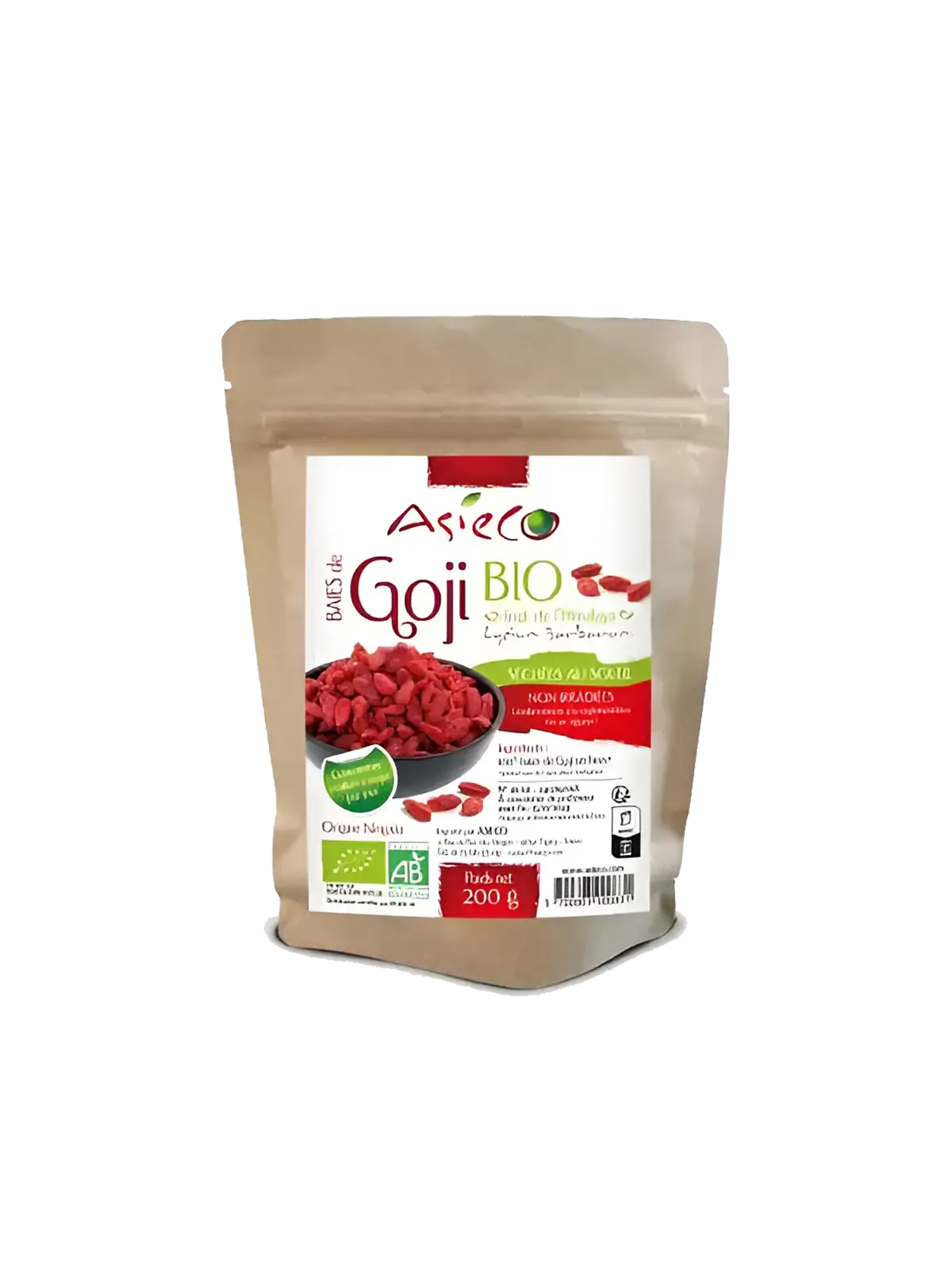
Organic goji berries from Ningxia, sun-dried, naturally rich in zeaxanthin and polysaccharides.
Grown in NingXia Province in southern Inner Mongolia, these berries are hand-harvested and sun-dried using traditional local methods. Enjoy them as is or incorporate them into a variety of recipes.
This product is a food item. It is not a substitute for medical treatment or a varied and balanced diet.
| Scientific name | Lycium barbarum L. |
|---|---|
| Common names | Goji, goji berry, common wolfberry, wolfberry |
| Botanical family | Solanaceae |
| Part used | Dried berries (fruits) |
| Composition | 100% organic goji berries (Lycium barbarum) |
| Drying | Traditionally sun-dried, not irradiated |
| Certification | Organic farming |
| Origin | Ningxia Province, Inner Mongolia, China |
| Packaging | 200 g bag |
The goji berry (Lycium barbarum) is a shrub of the nightshade family native to the arid regions of Central Asia, cultivated for centuries in the valleys and alluvial plains of northern China. Ningxia Province, located at the confluence of the Yellow River and the Gobi Desert, is considered the world’s historic benchmark region for goji cultivation: its unique climatic conditions—a wide temperature range, abundant sunshine, and alkaline soils rich in minerals—foster the development of berries with a particularly high concentration of active compounds.
These berries are harvested by hand, using the traditional expertise of local communities, and dried directly in the sun without industrial heat treatment. They are not irradiated, in accordance with European organic regulations, which prohibit the ionization of products derived from organic farming.
Botanically, goji berries differ from other common dried fruits in that they belong to the Solanaceae family, which also includes tomatoes, bell peppers, and eggplants. Its berries have a characteristic oblong shape, an orange-red color, and a slightly sweet flavor with a distinct herbaceous note.
This product is a food item. It is not a substitute for medical treatment or a varied and balanced diet.
To date, there is no EMA/HMPC monograph for goji (Lycium barbarum). The information presented below is based on nutritional and phytochemical data available in the scientific literature, as well as on traditional uses documented in Chinese medicine. No therapeutic claims are made.
The goji berry is one of the most concentrated dietary sources of zeaxanthin, a carotenoid in the xanthophyll family that is also found in egg yolks and corn. Zeaxanthin is naturally present in the macula of the retina, where it acts as a natural optical filter. Available studies on macular carotenoids—which include zeaxanthin and lutein—represent an active area of research in nutritional ophthalmology, although no health claims have been authorized at the European level specifically for goji berries.
The polysaccharides of Lycium barbarum, referred to in the scientific literature by the acronym LBP (Lycium barbarum Polysaccharides), are the most extensively studied compounds in the plant. These complex, species-specific polysaccharides are the subject of numerous research studies focusing on their biological properties, although their clinical implications in humans have not been established under European regulations. Their concentration is considered a quality marker for goji berries in the specialized literature.
Nutritionally, dried goji berries have a notable protein content (approximately 12 to 14% of dry weight, which is high for a fruit), as well as essential amino acids, dietary fiber, vitamins C and B (B1, B2, B6), as well as minerals: zinc, iron, selenium, calcium, and potassium. They also contain betaine, a specific amino acid involved in normal homocysteine metabolism, and beta-sitosterol, a plant phytosterol. The goji berry is ranked among the most nutritionally dense dried fruits in several comparative nutrition publications.
Goji is mentioned in the earliest Chinese pharmacopoeia treatises under the name gǒu qǐ zǐ (枸杞子). In traditional Chinese medicine, the goji berry is classified as a tonic for the liver and kidneys, and its daily use has been documented for over 2,000 years in the northwestern provinces of China, particularly in the Ningxia region, where local people traditionally consume a handful every morning. This status in the Chinese pharmacopoeia is the source of contemporary scientific interest in this plant.
The information above is derived from available scientific and ethnobotanical literature. It does not constitute health claims as defined by Regulation (EC) No. 1924/2006 and is not intended to replace medical or nutritional advice.
10 to 20 g per day, or about a small handful (20 to 30 berries, depending on their size). They can be consumed in one or two servings, preferably in the morning or midday.
Dried goji berries can be eaten directly, like dried fruit, without any preparation. Their slightly chewy texture and sweet, herbaceous flavor make them a pleasant snack at any time of day.
When soaked in a glass of cold or lukewarm water for 10 to 15 minutes, the berries rehydrate and regain a texture closer to that of fresh fruit. The soaking water, which is slightly colored and sweet, can be consumed at the same time.
Store away from heat, moisture, and direct light in an airtight container once opened. Dried goji berries are hygroscopic and may soften or clump together when exposed to moisture. Store in a cool place during the summer. Keep out of reach of children. Best consumed before the date indicated on the package.
Goji berries belong to the Solanaceae family: not recommended for people with a documented allergy or sensitivity to this botanical family (tomatoes, peppers, eggplants, etc.). Potential interactions with oral anticoagulants such as warfarin have been reported in the literature: if you are currently taking anticoagulant medication, consult a healthcare professional before regular consumption. Naturally contains sugars: take this into account if following a low-sugar diet.